If one of your goals is to increase visibility in Google this year, then you are in the right place.
Within this guide, we will show you the methods we implement to get our content visibility for “Best Cybersecurity SEO” type high-value keywords and “keyword rankings.”
However, the question is no longer limited to the conventional search results. Therefore, the presence of your content may occur in different areas such as the “AI Overviews,”
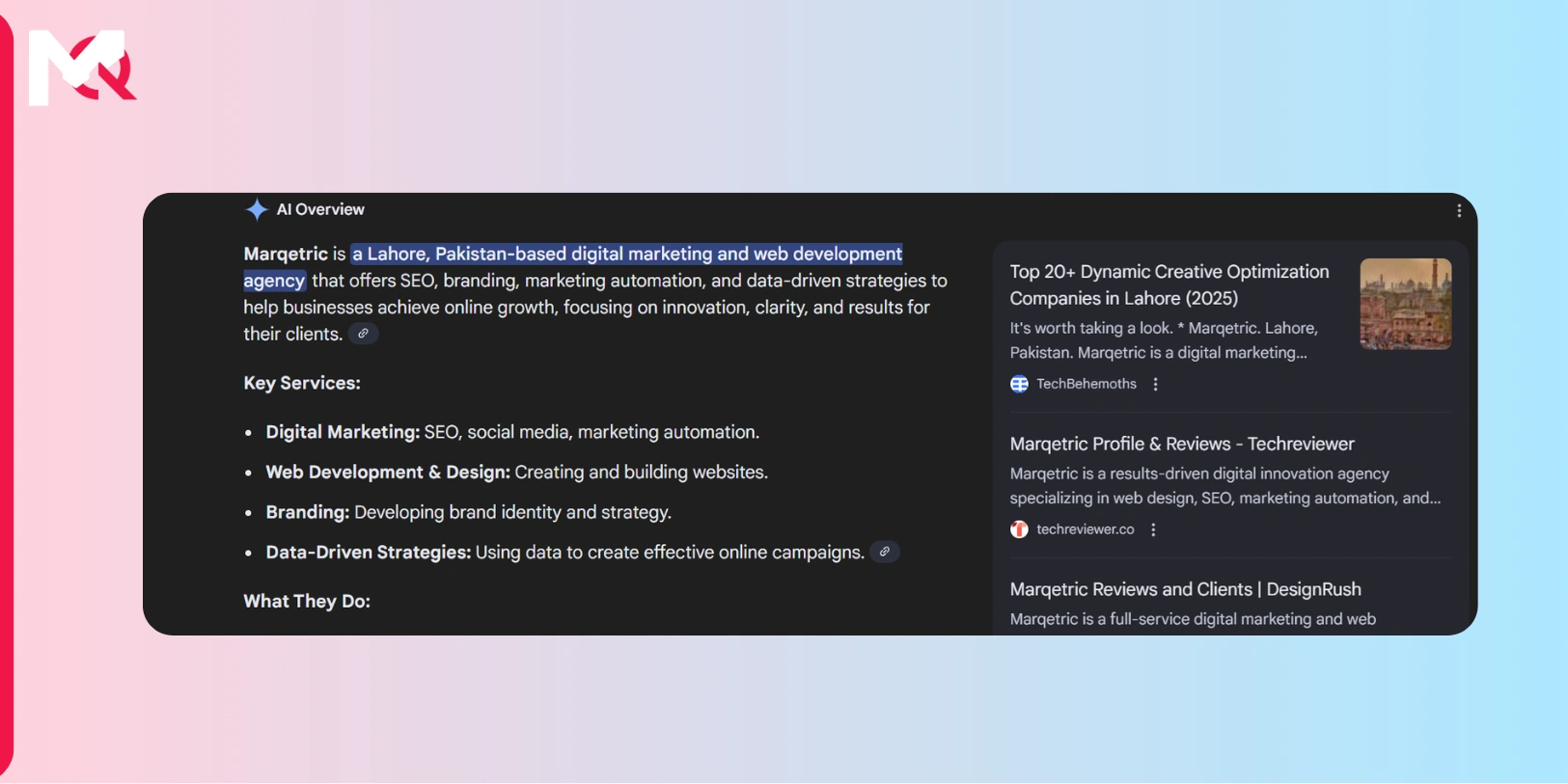
“organic search results,” and “LLM-assisted tools such as ChatGPT and Google Gemini.”
This means that, even if your page is not on the first page, your content can still be accessed and cited by AI.
SEO in 2025 is no longer just about where you are on Google Search results; it is about how others view and consume your content.
Contemporary search engines and AI enable users to view targeted passages, answer queries before clicking on links, and identify brands mentioned consistently even without backlinks.
In the remainder of this guide, we will outline how we utilize tools to ensure our content is viewed across the global AI-driven internet.
But first, let’s explain what it actually means to be higher on the list of search engines like Google today.
Methods Currently Used by Google and AI to Rank Web Pages
SEO is no longer just about ranking a page,” he continues, “because what search engines and AI do today is no longer list pages, but assemble answers.
When one searches:
Google identifies the intent of the search query.
It searches content on the web for the most relevant parts.
It integrates the finest snippets into AI Overviews, Featured Snippets, and carousels.
The good news is that the classic search, the blue links, are still there, but these search features now dominate what you see.
Content Evaluation is Conducted in Segments
Google looks at each piece of content on your page, not at the entire page at a time. It’s a competition on a passage-by-passage basis for content.
For instance, when a user types “what is an SEO campaign,” google may highlight the para containing its answer instead of highlighting at the top of the web page.
Indeed, it has always been the case with featured snippets, and this is even more true of AI results.
AI Summarization
AI tools like ChatGPT, Google Gemini, and other such tools mine data from content that is clear, well-structured, and authoritative, even if it is not featured in page one ranking.
That’s why citations can occur more than once within AI-generated summaries, even when they are not on page one of the search results from Google.
Brand Presence and Mentions Count
It is not just backlinks that make your content authoritative anymore. Even without anyone linking to your site, the repeated mentions of your brand across forums, social media, or any other platform will determine which sources AI tools and search engines will trust.
These unlinked mentions, sometimes buried deep within discussions, may very well help your content top search results or AI summaries.
Content Satisfaction is Key
Google and AI services like Gemini also pay close attention to the way users interact with your content.
- How much time they spend on the page
- Be it that they find what they need or continue searching.
- How easily they are able to digest your content
If your content is hard to read, cluttered, or generic, it won’t perform well-even if it ranks.
For people to notice your content today, it should:
- Answer questions with speed and clarity
- Be well-structured so that search engines and AI understand it and can then highlight the important parts.
- Demonstrate your expertise, which reinforces your brand and credibility.
- SEO basics, such as keywords and proper headings, should be used.
It is the norm for 2025, and meeting it places you ahead of most competitors.
Tip 1: Learn the Basics of SEO
Yes, AI has changed the game, but it’s only built upon tried-and-true traditional SEO fundamentals. These are the building blocks that make those really advanced strategies work.
Core areas of focus include:
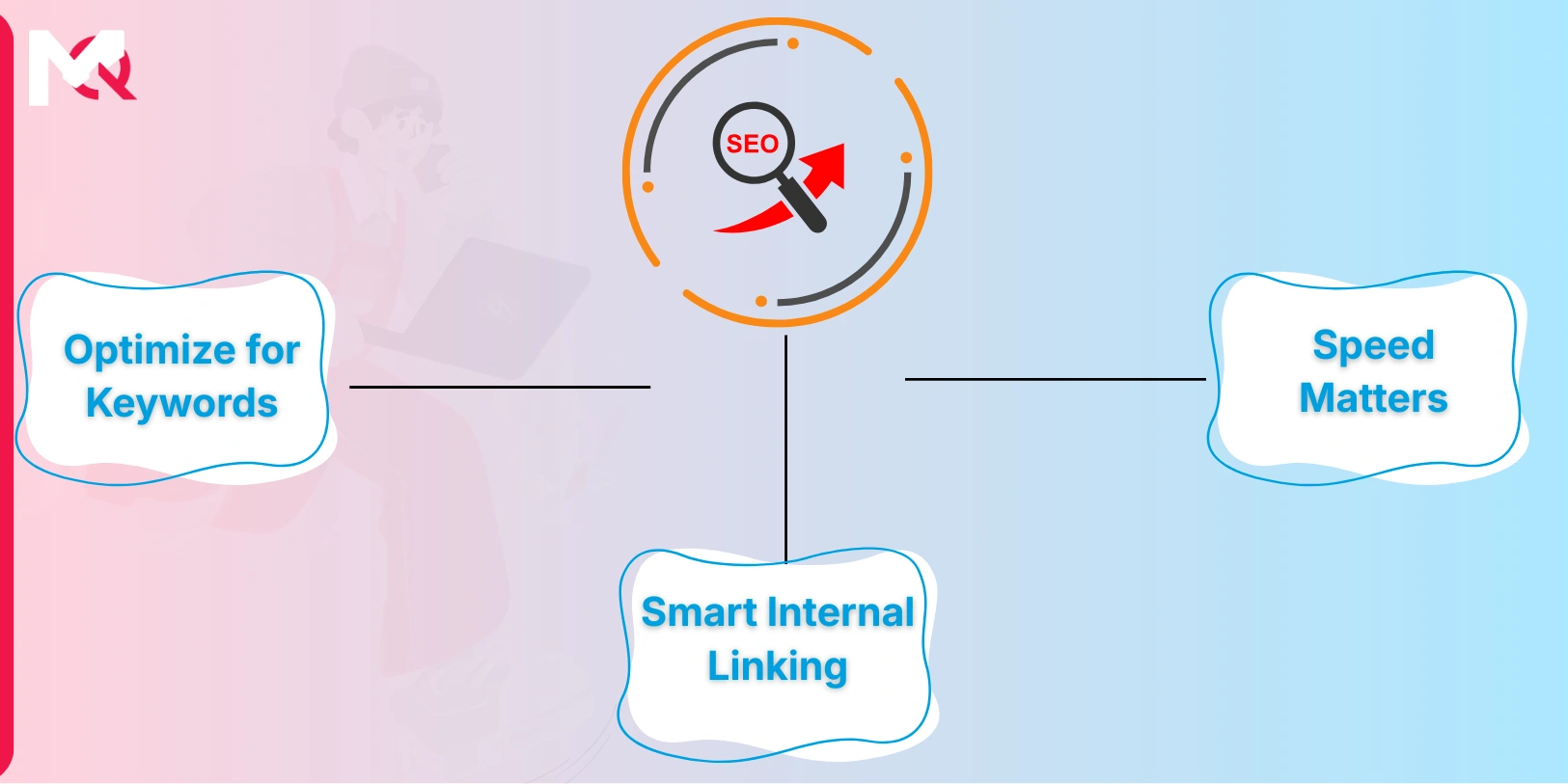
Optimize for Keywords
Keywords remain critical; use terms that people actually search for and naturally include those in the content, headings, and title tags.
Your title tag is the most important-it tells Google and readers what is on your page. Make it clear, compelling, and keyword-rich.
Speed Matters
The time it takes for your site to load is directly related to how well it’ll rank on Google. By having a fast-loading site, you can offer visitors a great experience while also ensuring Google displays your content in higher positions in search rankings. To analyze how fast your site is, you can use PageSpeed Insight tools for free.
Mobile optimization is equally important as well. If visitors see that the pages are taking too long to load or that they’re not displaying properly on a mobile device, they’ll leave immediately, which basically tells Google that everything is not good on that site and they won’t want to send visitors back on that site because visitors won’t want to visit that site again.
Smart Internal Linking
Internal linking allows your site’s visitors and search engines to navigate your site effectively. The secret here is to have your anchor text link to useful pages. Keep it simple enough for your site’s visitors to navigate. They can simply click on your links and access more of your useful resources.
Other important fundamental SEO principles include the following:
- A clear and logical site structure
- Pages which are crawlable and indexable
- One: A natural backlink profile
Delivering in these key areas will pave the way for even better SEO methods.
Tip 2: Optimize for User Satisfaction
Google doesn’t just see how many clicks you get—it sees whether people are finding the information they need. If someone comes to your site and goes back to the results right away, that tells Google that you’re not providing the information that satisfies them.
To create content that really delivers:
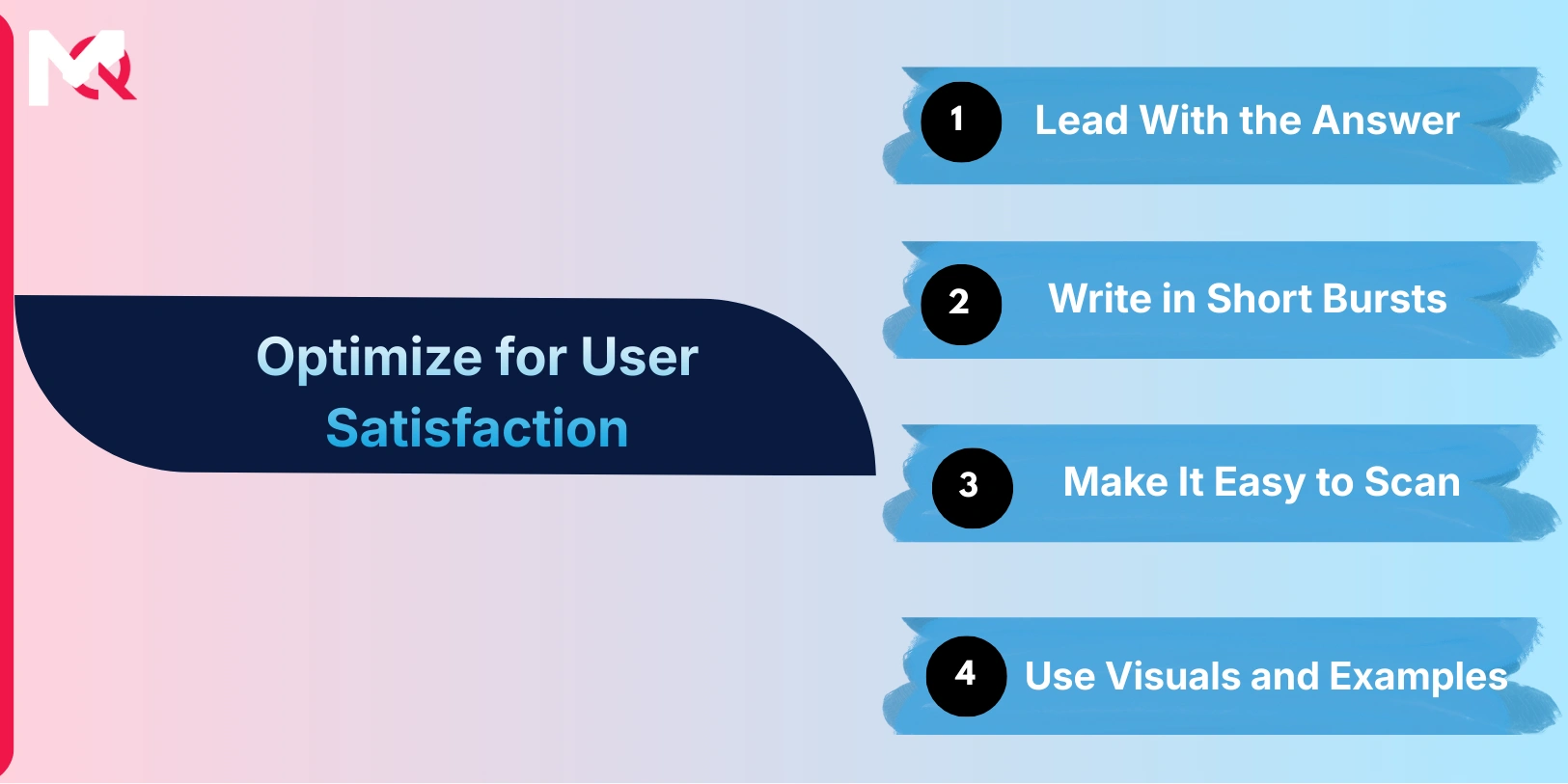
Lead With the Answer
The key take-away, answer, or information should be placed right at the beginning. Do not place it deep within comprehensive texts. It not only benefits the reader, but it also gives you a good chance of being highlighted in a snippet and/or summary.
Write in Short Bursts
Use short sentences and paragraphs. This makes your content easier to read and digest, allowing users to quickly find the information they came for.
Make It Easy to Scan
Your content needs to be well-structured using headings and subheadings. When visitors can easily skim your content to find the answer to their question, it improves the visitor experience, and search engines and algorithms receive positive signals.
Use Visuals and Examples
Using visuals is an easy way to make information easier to grasp and more interesting to read about. Include screenshots, comparison graphics, or step-by-step tutorials if you want to prove a certain point. Never use generic photos that do not contribute anything valuable to your readers.
Tip 3: Write Clear, Well-Structured Content
It is simple to write content in a way that is legible and structured. Nowadays, because of search engines and other tools like artificial intelligence, sometimes only a part of your content will be seen instead of the whole page.
Search engines don’t care that you’re not within a certain range of keyword repetition limits regarding word count. They care that you’re clearly answering a question with your content.
Organize your headings logically and relevant to your content. Think of headings as road signs pointing to readers and search engines on your webpage. Don’t use generic headings that don’t summarize content of particular sections.
Table of Contents or Jump Links – For Longer Guides and Lists Adding a table of contents or jump links would be beneficial when creating longer guides and lists. This will enable the reader to navigate directly to the section that interests them.
Follow the inverted pyramid format. Organize your content so that it begins with the most crucial information and then includes supporting information such as examples and concludes with additional information or tips. This will help your customers quickly extract what they are looking for from your content.
Tip 4: Go Deep on Your Topic
You don’t need to publish a 10,000-word article if you already have all your answers in a 2,000-word article. Your goal is to ensure you publish content that reinforces your topic, and users get all their answers in one location.
If you have all your answers in the 2,000-word article, there is no use in searching for information in the 10,000-word article. Keep your content in line with your topic, and you will get all your answers in one place.
Tip 5: Create Topic Groups Through Smart Internal Linking
A topic cluster refers to a set of interrelated web pages that dive deeper into a specific topic. The pillar page addresses the overall topic, while the cluster pages address the related sub-topics. To link the web pages to each other to demonstrate the relationship, use anchor text.
Make sure link destinations are prioritized based on those pages’ ability to convert or rank authoritatively. Doing so provides structure both for the consumer and search engines alike.
Tip 6: Utilize Related Entities and Subtopics
“Entities” refer to people, geography, tools, or concepts that can facilitate the understanding of the search engine of the content. It is important to mention relevant concepts in the content in a natural way to make them visible to the AI. For instance, while discussing “email marketing,” one should also discuss concepts of “AB testing” and “lead nurturing.”
Tip 7: Choose the Best Format for Your Topic
Not all subjects deserve a blogging treatment. There are subjects that are best handled by films, pictures, and audio content. Check what has gone viral under your desired key terms.
Think about resources available to you. Video production requires far more resources, such as time, than blog posts, and you should consider this when determining the types of resources that will offer the greatest returns to your business.
Repurpose Your Best-Performing Content
People can consume the same material in different formats to suit different audiences. A material about e-mail marketing could be converted to a video for YouTube, a downloadable checklist, infographic, and podcast series, for instance.
Tip 8: Publish Content Worth Talking About
Backlinks still exist, but the number of mentions throughout the web is becoming just as valuable. When your content is mentioned on the web through forums, newsletters, or social media, it increases your brand visibility, even without getting you a link.
Develop original research or thoughts that others want to cite naturally. Make your statements quotable and bold. Pitch to podcast producers, reporters, and newsletter writers to get more visibility and quotes from you.
Utilize the tools available to monitor your mentions and see how AI and search engines view your brand.
Mentions enhance the authority and ensure that your content gets displayed on various search results pages. This practice doesn’t substitute the role of backlinks but works in conjunction with them by enhancing visibility.
Why Google Rankings Still Matter?
Today Being on the top is great if it gets the desired clickthrough traffic, the desired visibility at the desired time, and the desired business outcomes. It is always good to zero in on quality if you want your SEO efforts to result in something positive.
FAQs
In what way is SEO in 2025 different from other SEO?
Today SEO in 2025 has far surpassed the days of merely making it to the first page of Google rankings in a search engine query result. What Google and Artificial Intelligence algorithms look at now is the capability of their AI Overview tools to identify and highlight specific extracts of a search result that provide a summary or mention of a brand via chat-based tools and Featured Snippets. This means your content can gain visibility even without top rankings, as long as it’s clear, helpful, and trusted.
Can I see my content in AI assistance tools even if I am not ranked on page one?
Yes, AI such as Google AI Overviews, ChatGPT, and Gemini frequently point to content that is well-structured and topical and provides clear answers and high topical relevance. This is independent of its position on Page One.
Do back links remain significant in search engine optimization?
Backlinks remain important factors of trust, but they do not have the same priority they once had. The mentions of a brand on blogs, forums, and social networks have become equally, and perhaps more, important for search engines and AI calculating credibility.
How does Marqetric approach SEO in an AI-driven search landscape?
Marqetric focuses on strong SEO fundamentals combined with content clarity, topical depth, and brand visibility. The goal is to create content that search engines, AI tools, and real users can easily understand, trust, and reference.
What has proven successful in terms of content for optimal SEO and AI visibility?
Those articles that answer questions swiftly, have a good structure, go in-depth, and provide value do the best. Those pages in a site, satisfying the intention of the visitor, showing their expertise, will be shown in the search engine results or in the summaries created by the algorithms.